In January 2026, users of a popular developer answer engine woke up to find it gone. The service shut down with no sunset window, roughly a month after announcing a fresh 10 million dollar raise, and deleted user data two weeks later. The cause was not scandal or fraud: general-purpose models had absorbed the one thing that made the tool special, and the economics stopped working. Nobody who relied on it got a warning worth acting on.
That pattern is now common enough to plan around. AI tools are being built, funded, and retired on compressed timelines, and the people most exposed are the users who wove a tool into a daily workflow. The good news is that discontinuation is rarely a bolt from the blue. It leaves a trail of observable signals, most of them checkable in a few minutes, and the earliest ones tend to appear long before any shutdown notice.
Discontinuation is normal, not rare
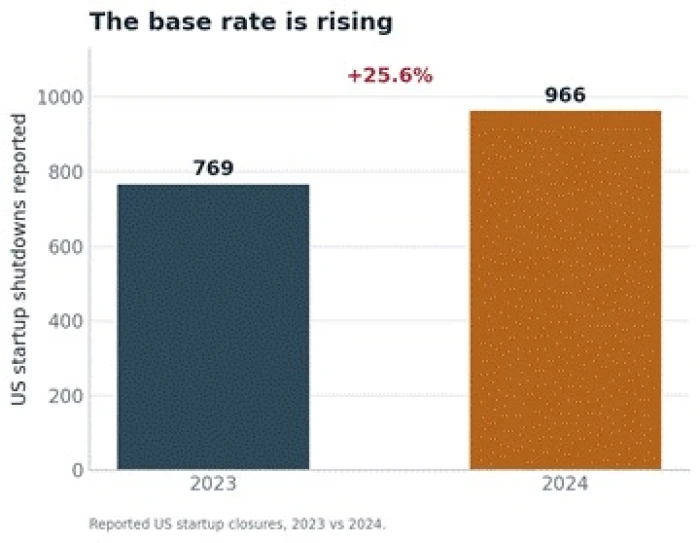
Before reading the signals, it helps to size the risk. Software products are retired all the time, and AI tools sit at the fragile end of that distribution. Reported United States startup closures rose from 769 in 2023 to 966 in 2024, an increase of about 26 percent, as cheap capital dried up and investors began asking how AI products actually make money.
The reasons are well documented. Analysis of hundreds of startup post-mortems by CB Insights finds that the leading cause of failure is not running out of money but building something the market did not need badly enough to pay for. Cash running out is usually the final event, not the root cause. A later CB Insights update reframed the top-line driver as poor product-market fit, with bad timing and unsustainable unit economics close behind. For a user, the lesson is that a tool can be well-built and still be discontinued, because the threat is commercial, not technical.
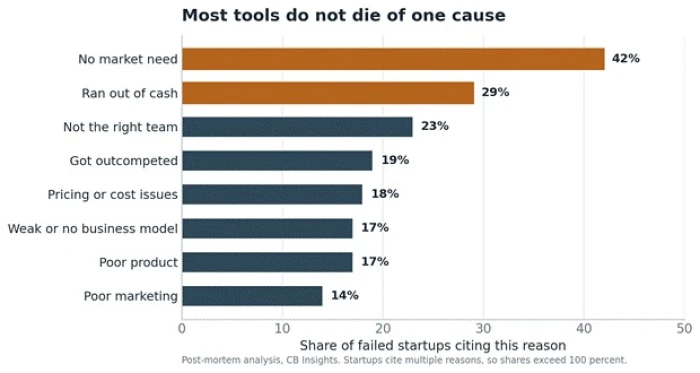
Figure 2. Post-mortem analysis of failed startups. Shares exceed 100 percent because most cite several reasons.
Why AI tools break more often than most software
A handful of structural forces make AI products unusually prone to sudden retirement, and recognising them turns a vague worry into a concrete risk assessment.
Thin wrappers get absorbed
Many AI tools are a friendly interface over a foundation model owned by someone else. When the underlying model gains the same feature natively, the wrapper loses its reason to exist. Several developer and productivity tools have closed for exactly this reason as the large model providers folded search, coding help, and summarisation into their core products.
The reverse acqui-hire has become an exit
A now-standard outcome sees a large company hire most or all of a startup's team, including its founders, and license the technology, without formally buying the company. This provides liquidity to the team while the original product is left to wither. When a favourite tool announces that its team is joining a big platform, the standalone product is usually the casualty, not the prize.
Compute is expensive and margins are thin
Serving AI features costs real money per query, and many tools priced their plans before that cost was clear. A product that cannot cover its inference bill, and cannot raise the next round to subsidise it, faces a short clock. This is why aggressive discounting or a sudden lifetime deal can be a warning rather than a bargain: it can signal a scramble for cash before the lights go out.
The signals, from strongest to softest
The table below is the practical core. It lists the observable signals in rough order of how strongly they predict a shutdown, alongside what each usually means. None is proof on its own, but two or three together, especially from different categories, are a reliable warning.
| Warning signal | What it usually means | Signal strength |
| A reverse acqui-hire or acquisition | The team joins a larger company and the technology is licensed. The standalone product is very often sunset within months. | Very high |
| A funding round that collapsed | A failed or pulled raise leaves little runway. Wind-down or a distressed sale usually follows within a quarter or two. | Very high |
| Founder or senior engineer exits | Departures of the CEO, CTO, or core builders drain the will and ability to keep the product alive. | High |
| Layoffs or a sudden 'refocus' | Cost-cutting and a narrowed focus frequently precede the quiet retirement of secondary products. | High |
| The changelog goes quiet | No meaningful releases for three to six months signals that engineering has moved on or thinned out. | Moderate to high |
| The mobile app stops updating | An app store 'last updated' date many months old points to a product on maintenance-only or no maintenance. | Moderate to high |
| The free tier is cut or a lifetime deal appears | Gutting free access, or a sudden lifetime or steep annual push, can be a final cash grab before shutdown. | Moderate to high |
| Support quality decays | Slow replies, canned answers, and vanished community managers show the team has shrunk or disengaged. | Moderate |
| The public roadmap is removed | A roadmap that quietly disappears removes the promise of a future the company no longer intends to fund. | Moderate |
| Docs, blog, and socials go stale | Months of silence across help docs and channels signals a marketing and product team that is gone or leaving. | Low to moderate |
| Prompts to export data or new wind-down terms | A sudden push to download data, or terms that mention deletion timelines, can be the last notice before the doors close. | High |
Signals differ not only in how much they predict, but in how easily a user can verify them. The most useful ones sit in the top-right: severe and quick to check. A stale app-update date or a silent changelog takes seconds to confirm and carries real weight, which makes them the sensible first look.
How the signals tend to sequence
The signals often arrive in a rough order. Financial and organizational cracks, a slipped funding round or a wave of departures, tend to come first and are the hardest to see from outside. Product neglect follows: the roadmap stalls, the changelog goes quiet, support slows. Commercial signals come later, as the free tier is cut or an annual push appears. By the time the community is openly asking whether a tool is dead, or export prompts and wind-down language surface, the decision has usually already been made.
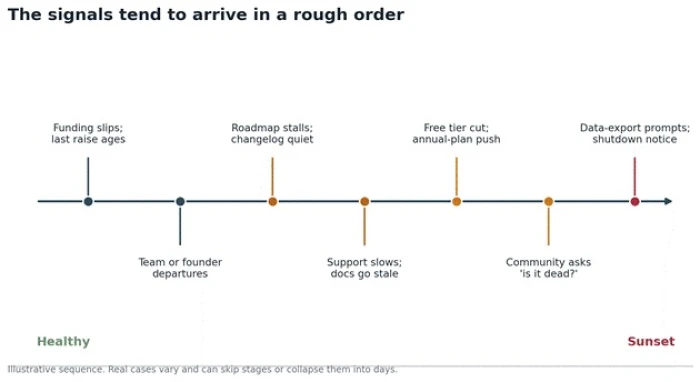
Figure 3. A rough progression. Abrupt shutdowns can compress every stage into a matter of days.
The acquisition tell, and what it did to real tools
Among all the signals, an acquisition or team-level acqui-hire is the single strongest predictor for AI tools specifically. The framing is almost always positive, a new home, more resources, an exciting next chapter, but for a standalone product the practical outcome is usually retirement. The documented cases below follow one script with small variations: the team moves on, the technology is folded into something larger, and the tool users depended on is switched off on a fixed date, sometimes with data deletion attached.
| Tool | What happened, and the tell | When |
| Phind | A developer answer engine shut down abruptly with no sunset period, barely a month after a fresh raise, once general foundation models folded search and coding into their core products. User data was deleted two weeks later. | Shut down January 2026; data deleted January 30, 2026 |
| Robin AI | A legal AI startup broken up in a distressed sale after a funding round collapsed. A law firm took the services arm and a big-tech buyer acqui-hired the engineers; the standalone product was in neither deal. | Round collapsed late 2025; broken up December 2025 to January 2026 |
| Supermaven | A well-liked code-completion tool acquired by the maker of a rival editor. The standalone service and its editor extensions were retired and folded into the acquirer's product. | Acquired November 2024; standalone sunset November 30, 2025 |
| Roi | A personal-finance AI app whose sole remaining founder was acqui-hired by a large AI lab. The app shut down and deleted user data on a fixed date soon after. | App shut down and data deleted October 15, 2025 |
| Lepton AI | An inference platform acquired by a major chip vendor. The standalone product was sunset as customers were migrated onto the acquirer's broader offering. | Acquired May 2025; standalone product being sunset |
| Limitless (formerly Rewind) | A hardware and transcription product acquired by a large platform. Hardware sales ended, the desktop app was sunset, and service was cut entirely in some regions. | Acquired December 2025; apps wound down |
The common thread is speed and finality. In several of these cases the gap between the cheerful announcement and the deletion of user data was measured in weeks. A user who treated the acquisition news as a prompt to export data and find an alternative lost nothing; a user who read it as reassurance lost their history.
What to do when the signs appear
- Spotting the signals is only useful if it changes behaviour. The following steps limit the damage without requiring a user to abandon a tool at the first hint of trouble.
- Export the data now, not later. At the first credible signal, pull a full export in a portable format. Exports are frequently the first thing to break when a service starts winding down.
- Stop prepaying for long terms. Once warning signs cluster, switch to monthly billing. A sudden lifetime or annual push from a shaky tool is a reason to be cautious, not to commit a year of budget.
- Line up an alternative before it is urgent. Identify and lightly test a replacement while the current tool still works, so a shutdown notice becomes an inconvenience rather than an emergency.
- Reduce lock-in deliberately. Favour tools with open formats and real export options, and avoid pouring irreplaceable work into a product showing multiple warning signs.
- Watch the team, not just the product. A quick check of whether founders and core engineers are still present, and still shipping, is often more predictive than any marketing page.
A two-minute health check
Any user can run this quick audit on a tool they depend on. Three or more yes answers, particularly across different categories, is a signal to export data and start looking at alternatives.
- Has the changelog or release feed been silent for more than three months?
- Is the mobile app's last-updated date more than six months old?
- Have the founder or core engineers recently left, or has the company announced layoffs?
- Has the company been acquired, or has its team joined a larger platform?
- Has the free tier been cut, or has a sudden lifetime or steep annual offer appeared?
Are the blog and support channels stale, with community members asking whether the tool is still alive?
Methodology: the Sunset Signal Framework
This analysis is organized around a simple framework that scores each warning sign on two axes: how strongly it predicts discontinuation, and how easily an ordinary user can verify it. The signal list and its ordering were assembled from three inputs. First, a review of documented AI product shutdowns and acqui-hires from 2024 through 2026, drawn from public shutdown trackers, company announcements, and reporting. Second, published research on why software companies fail, principally the CB Insights post-mortem analyses, used to distinguish root causes from proximate ones. Third, the recurring operational patterns that precede a wind-down, such as export prompts, stale release feeds, and support decay.
Two limits are worth stating. The predictive weights and quadrant positions in Figures 3 and 4 are an editorial rubric, a decision aid rather than a measured statistic, and individual cases vary. Every named case and every quantitative figure traces to public reporting or a cited dataset; none was invented. Specific claims about any single tool should be re-checked against its current status, because the situation of any given product can change quickly.
Verdict
An AI tool almost never disappears without notice; it disappears without a notice the user chose to read. The strongest early signals are organizational and financial, a collapsed raise, departing founders, an acquisition, and they tend to precede the visible product neglect that follows. The single most reliable tell for AI tools is the friendly acquisition announcement, which for a standalone product usually marks the beginning of the end rather than a new chapter.
The practical posture is neither panic nor blind loyalty. A user who periodically runs the two-minute health check, keeps exports current, avoids long prepayments on wobbly tools, and knows their fallback option converts the whole category of risk from a crisis into a scheduling problem. Tools will keep being discontinued. Losing work to one is the avoidable part.