The “Scroll Test” Every Marketer Is Failing
Spend five minutes scrolling any feed and a pattern emerges. A financial advisor’s post reads like a roofing company’s, which reads like a wellness coach’s, which reads like a law firm’s. Different industries, different audiences, different expertise and nearly identical marketing. The hook structures repeat. The carousel formats repeat. The em-dash-laden, briskly confident, faintly cheerful tone repeats. This is what practitioners now call AI content homogenization: the tendency for content produced with generative AI to converge on the same structures, phrases, tones, and ideas, regardless of which brand publishes it.
Here is the important nuance: this content is usually not bad. It is well written, grammatically clean, and properly structured. The problem is that it is indistinguishable from every other well-written, properly-structured piece on the same topic which makes it forgettable, and prevents it from building any brand equity at all. AI did not invent marketing sameness; identical “best practices” were spreading long before ChatGPT. But AI has poured accelerant on it, because it makes producing the safe, average, statistically-likely answer nearly free.
| “AI didn’t create sameness. It accelerated it.” When production becomes frictionless and everyone reaches for the same prompts, templates, and frameworks, content converges and industries that have nothing in common start to sound remarkably alike. |
The rest of this article does three things: it proves the effect is real with controlled data, explains why it happens at the level of the model itself, quantifies the business cost, and gives you a concrete framework to escape it.
What “AI Sameness” Actually Means
Homogenization is not one phenomenon but several, stacking on top of each other. Researchers typically measure it along four dimensions, and it helps to name them because a piece of content can be diverse on one axis and clone-like on another.
| Dimension | What it measures | How AI sameness shows up |
| Lexical | Word and vocabulary choice | The same signature words and phrases recur across unrelated brands |
| Syntactic | Sentence and paragraph structure | Identical rhythm: short hook, triad list, tidy takeaway |
| Semantic | Underlying meaning and ideas | Different companies surface the same handful of “safe” points |
| Stylistic | Tone, register, voice | A uniform upbeat-professional register regardless of the brand |
Crucially, homogenization operates at two levels at once. Intra-model sameness means one tool, prompted repeatedly, keeps returning to the same narrow set of ideas. Inter-model sameness means independently built tools from different vendors produce strikingly similar responses to the same brief. That second level is what makes the problem structural rather than a quirk of any one product: switching from one AI writer to a competitor rarely restores distinctiveness.
The Evidence: Sameness Is Measurable, Not a Vibe
It would be easy to dismiss “everything sounds the same” as nostalgia or bias. The stronger case is that homogenization has now been demonstrated in controlled experiments, natural experiments, and large-corpus analyses with numbers attached.
Exhibit A — The Creativity Paradox (Science Advances, 2024)
In a landmark experiment, researchers Anil Doshi (UCL) and Oliver Hauser (University of Exeter) had 300 participants write short eight-sentence stories. Some wrote alone; others could pull one or up to five story ideas from a large language model. The results captured the core tension of AI content in a single study.
• Individually, AI helped — a lot. Writers judged less creative produced work rated up to 26.6% better written and 15.2% less boring with AI assistance.
• Collectively, it homogenized. Stories written with a single shared AI idea were 10.7% more similar to one another than stories written without AI.
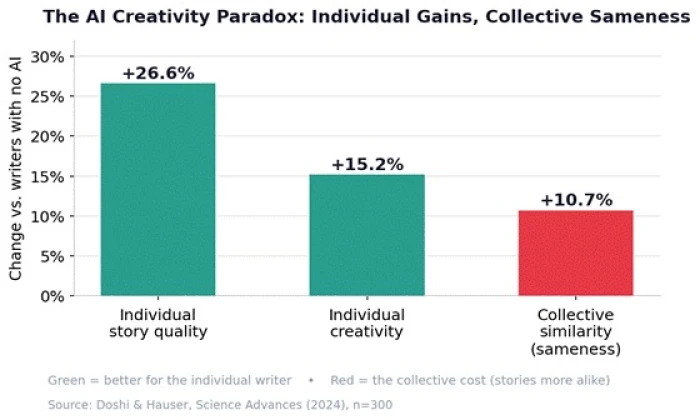
Figure 2. AI raised individual quality while making the pool of stories measurably more alike. Source: Doshi & Hauser, Science Advances (2024).
THE SOCIAL DILEMMA The authors describe a trap: if writers learn that AI-assisted work is rated more creative, each has an incentive to lean on AI more, but as everyone does, collective novelty shrinks further. Individually rational, collectively impoverishing. Marketing is living inside exactly this loop. |
Exhibit B — The Italy ChatGPT Ban (SSRN, 2025)
The best evidence would let you switch AI off and watch what happens. Italy’s country-wide ChatGPT ban in April 2023 did exactly that. Researchers Liu, Wang and Yang treated it as a natural experiment, studying the Instagram marketing of restaurants in Milan, a fragmented industry where roughly 70% of establishments are independently owned.
During the ban with AI unavailable, restaurants’ content became measurably more diverse across every dimension: 15% more lexical variety, 12% more syntactic variety, and smaller gains in semantic and stylistic variety. In other words, access to ChatGPT had been actively pushing their marketing toward sameness.
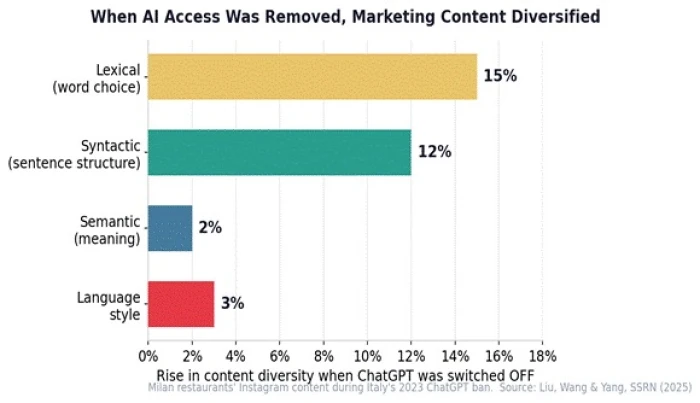
Figure 3. Removing AI access increased content diversity on all four axes. Source: Liu, Wang & Yang, SSRN (2025).
The kicker: the ban was associated with a roughly 3.5% increase in average likes. Less homogenized content engaged audiences more, not less, a direct rebuttal to the assumption that AI-optimized copy is automatically higher-performing.
Exhibit C — It Replicates Everywhere Researchers Look
These are not two isolated findings. The same signal appears across independent studies and content types:
• Admissions essays: An analysis of 2,200 essays found human-written work contributed roughly two to eight times more collective semantic diversity than GPT-4-generated essays (Moon et al., 2025).
• Idea generation: When people brainstorm with the same AI tool, they generate more ideas individually but converge as a group, the model feeds similar suggestions to different users (Anderson et al., 2024).
• Lexical diversity: LLMs have been shown to use fewer unique words and exhibit lower lexical diversity than humans (Reviriego et al., 2024).
• Cultural flattening: AI writing suggestions have been found to homogenize prose toward Western styles, sanding down cultural nuance (Agarwal, Naaman & Vashistha, CHI 2025).
Why It Happens: Four Forces Pulling Toward the Mean
Understanding the mechanism matters, because it tells you which fixes actually work. Sameness is not a bug someone forgot to patch; it falls out of how these systems are built and used. Four forces compound.
1. Overlapping training data
Large language models are trained on vast, heavily overlapping slices of the public internet. Different vendors scrape much the same corpus, so their models internalize the same dominant patterns of “what marketing copy looks like.” Before you type a word, the priors are already shared which is a large part of why inter-model sameness exists at all.
2. Next-token prediction favors the average
At its core, an LLM predicts the most statistically likely next token. “Most likely” is, by definition, the least surprising, the center of the distribution. Left to its defaults, the model gravitates to the safe, expected phrasing rather than the idiosyncratic turn that would make copy memorable. Distinctive writing lives in the low-probability tail the model is built to avoid.
3. Alignment training (RLHF) narrows the range
To make models helpful and safe, labs fine-tune them with Reinforcement Learning from Human Feedback (RLHF). This is invaluable, but it has a well-documented side effect researchers call mode collapse: RL fine-tuning reduces the diversity of a model’s outputs, pushing it to emit a narrow band of high-scoring, reviewer-pleasing responses. The very process that makes a model pleasant to use also sands off its edges. Studies find alignment-tuned models converge on “attractor” phrasings and a constrained stylistic range.
WHY “SWITCH TOOLS” DOESN’T FIX IT Because sameness comes from shared data plus shared training objectives, not one company’s secret sauce moving from one AI writer to another gives you a different flavor of average, not genuine distinctiveness. Recent work even finds semantic convergence emerging at inference time through recursive self-conditioning, independent of training. The pull toward the mean is structural. |
4. Human workflow convergence
The final force is us. Marketers share the same prompt templates, follow the same “best-practice” frameworks, and feed near-identical briefs into near-identical tools. When thousands of teams ask the same question the same way, they get back variations of the same answer, and then publish them. The technology sets the floor; our habits pour the concrete.
What Homogenized Content Costs Your Brand
If the output is competent, why care? Because marketing only pays off when it is remembered, and memorability requires difference. Three costs are now showing up in the data.
1. Eroding consumer trust
Trust in AI-generated content is falling fast. Capgemini’s longitudinal research tracked it sliding from 73% in 2023 to 55% in 2025, a decline recorded across every age group, including digital-native Gen Z.
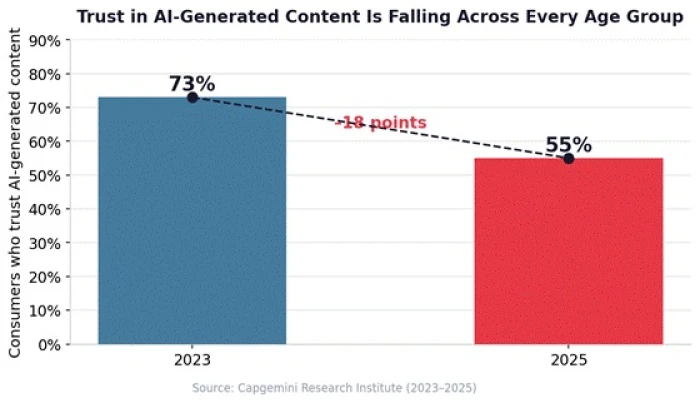
Figure 4. Consumer trust in AI-generated content dropped 18 points in two years. Source: Capgemini Research Institute.
Other 2026 surveys point the same direction: roughly a third of consumers say they trust a brand less when it uses visible AI-generated content, and a Gartner survey found half of US consumers prefer brands that keep generative AI out of customer-facing messaging. As audiences get better at recognizing the “AI voice,” sameness stops being neutral and starts signaling low effort.
2. Lost differentiation and brand equity
Consumers do not bond with brands that sound like everyone else; they bond with brands that feel distinct. When AI generates the same blog posts, ads, and captions industry-wide, the emotional signals that define a brand’s personality get diluted. Authentic brand stories come from insight, lived experience, and values none of which live in the training data the model is recombining. Check every SEO box and you can still produce something no one remembers by lunchtime.
3. The SEO trap: competent, indexed, invisible
For search specifically, sameness is doubly dangerous. Search engines increasingly reward demonstrable experience and originality; a page that restates the same points as forty competitors offers no reason to rank it above them. And with AI-generated material projected to make up a growing share of all web content, “average” is a rising tide, the bar for standing out keeps climbing. Distinctive, experience-backed content is now the moat, not the nice-to-have.
How to Escape the Sameness Trap
The goal is not to abandon AI, its speed and leverage are real. The goal is to change where AI sits in your workflow: use it for scaffolding, not for soul. Here is a framework that keeps the efficiency while restoring distinctiveness.
1. Lead with proprietary inputs the model can’t have
The single most effective defense is feeding content something the training data lacks: your first-party data, original research, customer interviews, support-ticket patterns, real case numbers, and named lived experience. A model can recombine what exists; it cannot invent your Q3 churn analysis or the thing a customer said on a call last Tuesday. Originality of input forces originality of output.
2. Make AI the editor, not the author
Draft the argument, the angle, and the opinionated bits yourself; let AI tighten, restructure, and check. This inverts the default workflow and keeps your voice at the center. The Italy study is a reminder that the human-first pool was the more diverse, and more engaging, one.
3. Push the model off the mean, deliberately
If you do generate with AI, fight the pull to the average on purpose:
• Give it a specific, strongly-voiced persona and real constraints, not “write a professional blog post.”
• Feed it your actual style samples and ask it to match rhythm and vocabulary.
• Ban the tell-tale phrasings and structures you see everywhere in your niche.
• Where the tool allows, raise sampling temperature for ideation drafts, then edit down.
4. Evaluate for voice, not just correctness
Most content review checks grammar, accuracy, and structure, precisely the things AI already does well, and precisely the axes on which everyone converges. Add a distinctiveness check: would a reader who covered the logo know it was you? Does it carry a point of view a competitor couldn’t safely publish? Grade for emotion, nuance, and strategic fit, not speed.
5. Protect a human core
Reserve your highest-stakes, brand-defining content, founder POV pieces, positioning, signature campaigns, as human-first zones. Use AI to scale the supporting layer, but never let the recombination engine define what the brand actually stands for.
THE ONE-LINE STRATEGY Use AI to remove friction, never to supply the point of view. Distinctiveness comes from proprietary inputs and human judgment; let the model handle everything downstream of that. |
Conclusion: Average Is a Losing Strategy
AI-generated marketing feels the same because, mechanically, it is engineered to: shared data, next-token prediction, and alignment training all pull toward the statistical middle, and human workflow habits push the rest of the way. The evidence from controlled experiments to a country-scale natural experiment shows the effect is real, measurable, and already costing brands trust and recall.
But the same research points to the escape route. Sameness lives in the average; distinctiveness lives in the inputs a model can never possess, your data, your experience, your point of view. The brands that win the next few years will not be the ones that generate the most content fastest. They will be the ones that use AI to clear the busywork and spend the reclaimed time being unmistakably themselves.