

The quick answer, before I go down the rabbit hole Three sellers almost never share one price because three forces stack on top of each other: each store is a separate business with its own costs and margins, prices shift in real time with demand and competitors (dynamic pricing), and the page may quietly tailor an offer to you using your location, device and history (personalized pricing). Peel those three layers apart and the mystery dissolves. |
It started with a pair of headphones
Last month I did something small that sent me down a surprisingly deep hole. I was hunting for a particular pair of wireless earbuds, and out of habit I opened the same model in three browser tabs: a giant marketplace, the brand's own store, and a cashback-style deal site I like. Three tabs, one product, identical model number. The numbers staring back at me were $84, $79 and $69.
My first reaction was mild outrage. My second was pure curiosity. Was someone playing games with me? Had I been flagged as a soft touch who would pay more? Or was there a boring, mechanical explanation hiding behind the drama? I am the sort of person who cannot let a question like that sit, so I started reading, and what I found was far more interesting than a simple rip-off.
What follows is the trail I pieced together, with the sources that actually hold up. I have tried to separate what is proven from what is merely suspected, because this topic attracts a lot of breathless claims. Let me walk you through it the way I worked through it myself.
Am I looking at dynamic pricing, price discrimination, or something sneakier?
The first thing I had to sort out was vocabulary, because three terms get thrown around as if they mean the same thing. They do not. Economists have studied this for a century, and the classic framework sits under the umbrella of price discrimination, the practice of charging a different amount for essentially the same good. It splits into three recognised degrees, and keeping them straight made everything else click into place.
Dynamic pricing is the cousin that confuses everyone. It describes a price that moves with market conditions: demand, supply, the hour of the day, what rivals are doing, rather than a price tuned to a specific person. Airline seats and ride-hailing surges are the textbook cases. Personalized pricing goes one step further and sets a figure based on who it thinks you are. The table below is the cheat sheet I wish I had started with.
| Term | What moves the number | A familiar example |
|---|---|---|
| Dynamic pricing | Live market signals: demand, stock levels, time, season, competitor moves | A flight that costs more on Friday evening than on Tuesday morning |
| Price discrimination | Which group you fall into — your willingness to pay, quantity or segment | Student, senior and off-peak discounts |
| Personalized pricing | Signals specific to you: location, device, browsing and buying history | Two people quoted different figures for the identical item at the same moment |
| Cross-retailer pricing | Each seller's own costs, fees, margin and strategy | The same blender priced three ways across three shops |
Table 1 — Four overlapping ideas that people tend to lump together.
Once I had those boxes, I realised my three-tab puzzle was not one phenomenon at all. It was three different things happening together. So I tackled them one at a time.
Reason one: every store is really a different business wearing the same logo
Here is the point I kept forgetting: when I compare three websites, I am not comparing three price tags on one shelf. I am comparing three separate companies that each had to buy, store, market and ship that product, and each one needs to make money doing it. The product is identical; the business behind it is not.
Picture the sticker price as a stack of blocks rather than a single slab. The wholesale cost of the item usually sits at the bottom and is roughly the same for everyone. Everything above it varies wildly: the commission a marketplace charges its third-party sellers, warehousing and delivery, returns, advertising, and whatever profit each seller decides to take. Change any block and the total shifts, even though the thing in the box never changed.
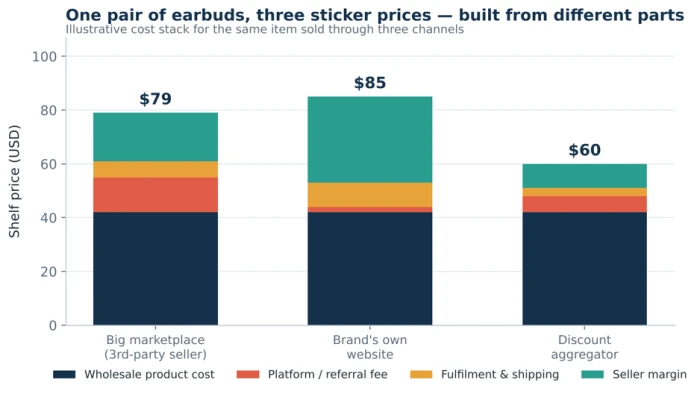
Figure 1 — An illustrative breakdown of why one item lands at three prices across three channels.
Why does the marketplace version cost more than the brand's own site?
On a large marketplace, the seller you buy from is often a third party, not the platform itself, and that seller pays a referral fee on every sale, frequently in the mid-teens as a percentage. That cut has to come from somewhere, so it is baked into the price. The brand's own website skips the middleman entirely, which can mean a lower figure or, just as often, a higher one that the brand props up to protect its premium image and avoid undercutting its retail partners.
There is also a hidden rulebook at work called MAP, short for Minimum Advertised Price. Manufacturers hand retailers a floor below which they are not allowed to advertise a product. It governs the displayed number, not the final checkout total, which is exactly why a site can show a blanked-out price and only reveal the real one in the cart. When you see 'add to basket to see price', MAP is usually the reason.
What is the Buy Box, and why does it change the price I see?
On marketplaces where many sellers list the identical product, only one offer wins the prominent buy button at any moment, the so-called Buy Box. By most industry estimates it carries the overwhelming majority of a listing's sales, often cited at above 80%. Sellers run automated repricing software that nudges their numbers up and down around the clock to capture it, so the figure you catch depends on who is winning that silent auction the second you load the page. This is competition, not conspiracy, but it means the 'price' of a popular item is less a fixed fact than a moving average.
Reason two: the price tag moves while I am standing still
The second layer is time. Even on a single site, the amount can drift between breakfast and dinner, and that drift is deliberate. Retailers increasingly let algorithms adjust figures continuously in response to demand, inventory and the moves of their rivals. When stock runs low or interest spikes, the number creeps up; when a warehouse is overflowing or a competitor cuts, it slides down.
This is not a fringe tactic any more. The software industry that powers these shifts has grown into a sizeable market in its own right, and the trajectory is steep. According to Global Market Insights, the dynamic-pricing and yield-management sector was worth about $5.2 billion in 2024 and is projected to roughly double over the following decade. A separate 2025 estimate from the consultancy Valcon suggested that more than 60% of European retailers had already adopted some form of AI-driven dynamic pricing. In other words, the shifting number is becoming the norm, not the exception.
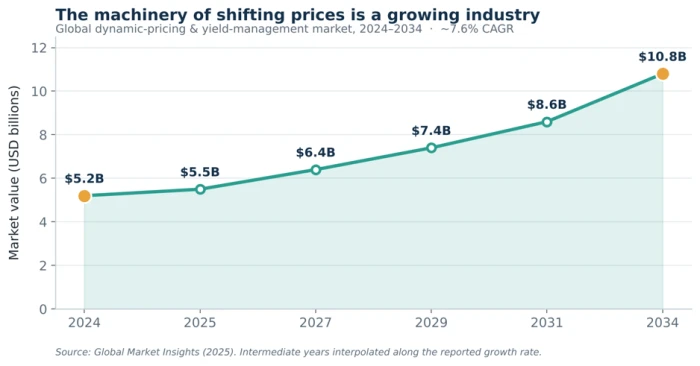
Figure 2 — The tooling behind moving prices is a fast-expanding industry.
So is it worth refreshing the page or waiting a day?
Sometimes, genuinely. Because dynamic pricing swings both ways, patience can be rewarded with a dip just as easily as it can punish you with a spike. Travel is the sharpest example, fares and room rates can change hour to hour, but electronics, appliances and fashion all flex too. I have started treating a single price as a snapshot rather than a verdict, and checking back before any purchase I am not in a hurry to make.
Reason three: the website thinks it knows me
This is the layer that unsettles people the most, and it is where I had to be most careful to separate fact from folklore. The idea is simple and a little chilling: rather than reacting to the market, the page reacts to you, estimating how much you personally might be willing to part with and shaping the offer accordingly.
I did not have to rely on rumour here, because a regulator has looked under the hood. In January 2025 the US Federal Trade Commission published initial findings from a study of what it calls 'surveillance pricing'. Its staff reported that retailers can use deeply personal signals, a shopper's precise location, demographics, browsing patterns, purchase history, and even the way a cursor moves across a webpage to set individualised figures.
The scale surprised me. As Bloomberg reported on the same findings, the intermediary firms the agency examined were working with as many as 250 businesses to help target prices, profile customers or reorder what products appear first. Many of these middlemen operate out of sight, hired by retailers precisely so the shopper never sees the machinery.

Figure 3 — How scattered personal signals get funnelled into a single tailored number.
Has a real company actually been caught doing this?
Yes, and the examples are instructive precisely because they caused such backlash. Back in 2000, Amazon was caught charging different customers different amounts for the same DVDs during a five-day test across 68 titles, with discounts varying by as much as 20% to 40%. Shoppers compared notes, fury followed, and the company apologised, refunded roughly 6,900 buyers an average of a few dollars each, and insisted the experiment was never based on customer demographics. The episode became a cautionary tale that still shapes retail behaviour today.
A dozen years later, NPR and the Wall Street Journal reported that the travel site Orbitz had noticed Mac users spending $20 to $30 more a night on hotels and were far likelier to book four- and five-star rooms, so it began steering them toward pricier options. Worth stressing: Orbitz said it was reordering which hotels appeared first, not charging two people different rates for the identical room. The distinction matters, and it is the kind of nuance that gets lost when a story goes viral.
Does being on a phone or a Mac really change my price?
Device type is a documented input, but its effect is easy to overstate. The Orbitz case was about ranking and recommendations, not a surcharge for owning an Apple laptop. More broadly, your operating system can feed into the profile a site builds, and mobile apps sometimes run their own separate promotions. The honest answer is that your device can nudge what you are shown, but the lurid claim of a flat 'Apple tax' at checkout is rarely borne out. I test it anyway, more on that shortly.
Did I imagine the differences, or is this genuinely legal?
This was the question that nagged at me most. Charging two neighbours different sums for the same goods feels like it ought to be against the rules. For the most part, in the United States and many other markets, it is not, provided the pricing is not built on protected traits like race, and provided no outright deception is involved.
What is shifting is the expectation of transparency. In August 2026 the FTC proposed an enforcement policy signalling that it would treat undisclosed personalized pricing as potentially deceptive under existing consumer-protection law. The proposal stopped short of banning the practice outright, the agency has been clear it lacks the authority to do that, but it would push retailers to disclose when a price has been tailored and what data drove it. Several states have moved faster: New York now requires disclosure of algorithmic personalized pricing, while Maryland and New Jersey have restricted it specifically in groceries.
The strangest fact I unearthed is how little shoppers know their rights here. A survey by the Annenberg Public Policy Center at the University of Pennsylvania found that 64% of American adults did not even realise it was legal for an online store to charge different people different amounts at the same time. That knowledge gap is arguably the real problem, not the pricing itself, but the fact that so few of us know it is happening. Academics who model the ethics of personalized pricing find that whether it helps or harms society depends heavily on perceived fairness and on how much people resent the surveillance behind it.
What I now do before I click 'Buy'
Understanding the mechanism changed how I shop. None of these habits are exotic; together they have saved me a meaningful amount, and more importantly they have replaced that vague feeling of being cheated with a sense of control. Here is my routine.
| My habit before buying | Why it works |
|---|---|
| Open the same item in three or four places | Cross-retailer gaps are the biggest and most reliable source of savings, bigger than any personalization trick |
| Compare in a private or incognito window | Strips away cookies and login history, so I can see whether a profile-based figure appears |
| Check once on mobile and once on desktop | Apps and mobile sites sometimes carry their own promotions, and device can shade what is shown |
| Let a non-urgent item sit for a day or two | Dynamic pricing swings both ways, so waiting often surfaces a dip rather than a rise |
| Read the total, not the headline | Shipping, fees and MAP games mean the advertised number rarely equals what I actually pay |
| Watch the price history, not a single snapshot | A tracker reveals whether today's figure is a genuine deal or just the normal ceiling |
Table 2 — The short checklist I run before any purchase I care about.
The single most effective move, by a wide margin, is the first one. The differences between separate retailers dwarf the few percent that personalization might add or subtract, so the humble act of comparison remains the shopper's strongest tool. The fancy algorithms get the headlines; plain old competition still decides most of the gap.
The bigger question: is any of this actually fair?
After all the reading, I landed somewhere more nuanced than my first flash of indignation. A price that moves with supply and demand is not sinister, it is how markets have always worked, just faster and more automated. Different shops charging different amounts is simply competition doing its job, and it usually works in my favour if I bother to look around.
Where my unease remains is the quiet, personal layer: the idea that a hidden model sizes me up and decides what I can be made to pay, without ever telling me it is doing so. The economics of that are debatable; the lack of disclosure is harder to defend. What tips the balance is knowledge. A shopper who understands the three layers is not a victim of them, they are simply a better-informed participant in an old game that has gone digital.
So the next time three tabs show me three numbers, I will not feel cheated. I will feel curious, open a fourth tab, and remember that the cheapest price is almost always sitting one comparison away.
Frequently asked questions
Why is the same product cheaper on one website than another?
Because each website is a distinct business with its own wholesale deals, platform fees, shipping costs and profit margins. On marketplaces, third-party seller commissions and the Buy Box contest add further variation, so an identical item routinely carries different figures across sellers.
Is it illegal to charge different customers different prices online?
In most markets, no, as long as the pricing is not based on protected characteristics such as race and involves no deception. Regulators are now pushing for disclosure rather than a ban; the US FTC proposed in 2026 that undisclosed personalized pricing could be treated as deceptive.
Can I really get a lower price by using incognito mode?
Sometimes. A private window removes cookies and sign-in history, which can reveal whether a profile-based figure was being applied. The effect is usually modest, and comparing across different retailers tends to save far more than clearing your cookies on one.
Do Mac users or iPhone users pay more?
Device type can influence what a site shows you, as the 2012 Orbitz case demonstrated, but that was about which hotels appeared first, not a surcharge on identical rooms. A blanket 'Apple tax' at checkout is largely a myth; checking on more than one device is still a sensible habit.
What to remember Three prices on three sites is three things at once: separate businesses with separate costs, prices that move with the market, and offers that may be shaped around you. The cure for all three is the same — compare widely, read the full total, and treat any single number as a snapshot rather than the truth. |