

Churn between AI assistants, models and platforms is no longer anecdotal. Here is what the 2026 data actually shows about who is switching, what triggers a move, which categories are barely affected, and how to tell a rational switch from an expensive one.
In May 2025, ChatGPT accounted for 79.0% of web visits across the seven largest AI assistants. Twelve months later that share had fallen to 53.9%. Separate app level data from Sensor Tower put the figure at 46.4% by the end of May 2026, the first time the product had held less than half its market since launching in November 2022.
The decline is not the interesting part. Combined traffic across those seven assistants grew roughly 49% over the same twelve months while ChatGPT's own visit count stayed close to flat. Almost nobody left in absolute terms. Growth went elsewhere, and a measurable share of existing users began keeping more than one assistant open and moving work between them.
That pattern now repeats across coding assistants, writing tools, meeting notetakers and enterprise model APIs. It is worth understanding precisely, because the causes have less to do with disloyalty than with four structural conditions that simply did not exist two years ago.
Switching Has Stopped Being Anecdotal
For most of 2023 and 2024, claims about AI tool churn rested on forum threads and vendor talking points. Three independent datasets now point the same direction, each measuring a different layer of the market.
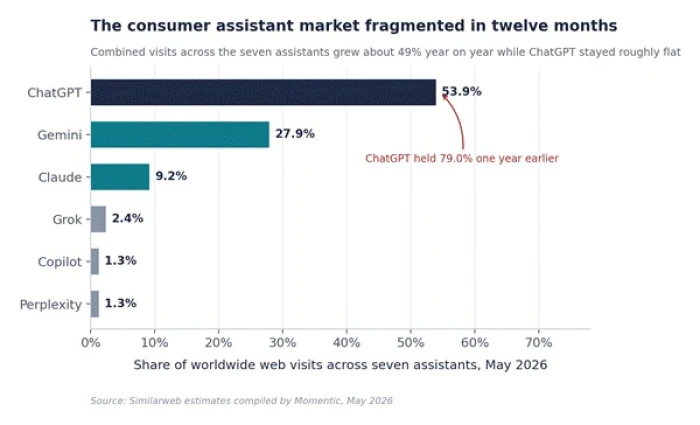
Figure 1: Assistant traffic fragmented while the overall category expanded. Share data from Similarweb estimates compiled by Momentic, May 2026.
At the consumer layer, Sensor Tower's State of AI 2026 report found users increasingly willing to move between assistants rather than settle on one. Gemini's climb is largely a distribution story, driven by placement inside Search, Android and Workspace. Claude's rise, at roughly 855% growth in web visits year on year, came from professional and coding workloads. Neither displaced ChatGPT so much as absorbed the market's growth.
At the subscription layer, RevenueCat's State of Subscription Apps 2026 found that AI powered apps convert free trials into paid subscriptions at 8.5% against 5.6% for non AI apps, and generate about 41% more revenue per user. The same apps retain only 21.1% of annual subscribers after a year, against 30.7% for everything else. AI apps are markedly easier to sell and markedly harder to keep.
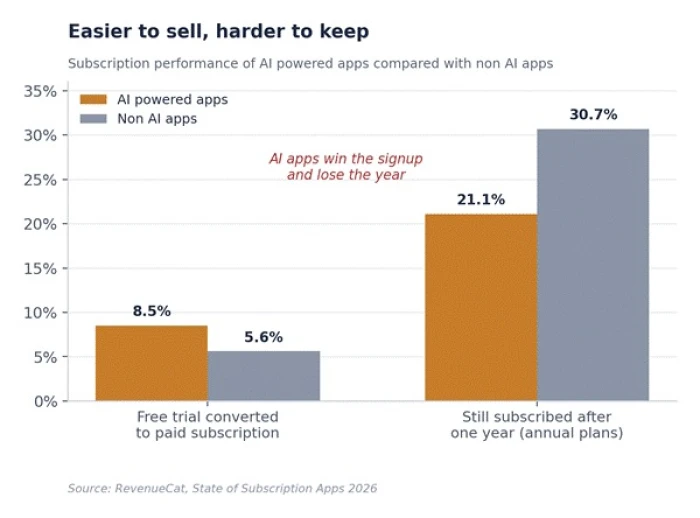
Figure 2: The conversion advantage and the retention penalty come from the same behaviour, namely fast trial driven purchasing. Source: RevenueCat, State of Subscription Apps 2026.
At the product layer, a shutdown tracker covering 2,718 AI tools recorded 254 shutdowns or acquisitions by August 2026, a 9.3% product level failure rate. Acquisition was the most common exit, and just over half of acquired products continued shipping under their own brand. A meaningful slice of switching is therefore involuntary.
One caveat belongs alongside every number above. These firms count different things: weekly actives, monthly actives, web visits and app installs are not interchangeable, and published estimates for the same platform in the same month have differed by more than twenty percentage points. The direction is consistent across methodologies. The precise levels are not, and any analysis that treats a single share figure as settled fact is overreaching.
The Switch Cost Stack: Four Layers That Used to Hold Buyers in Place
Software loyalty has never been mainly about satisfaction. It is about the cost of leaving. In conventional enterprise software that cost sits in four layers, and in the AI category three of the four have thinned considerably since 2023.
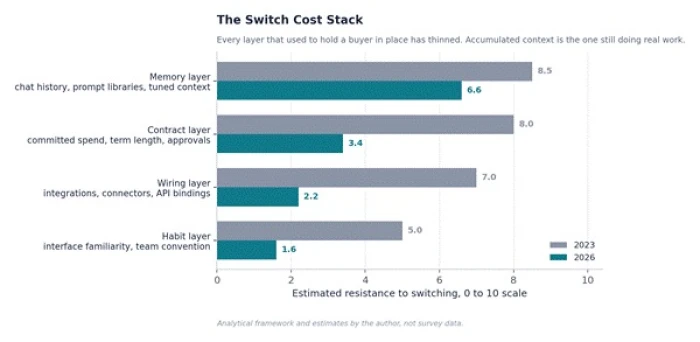
Figure 3: The Switch Cost Stack, an analytical framework for estimating how expensive a given move would actually be. Scores are the author's estimates, not survey data.
The habit layer went first
Interfaces converged almost immediately. A chat box, file upload, project folders, voice input and a document style canvas now appear in nearly every major assistant. Prompting skill transfers between products with very little loss. The interface complexity that historically locked users into spreadsheet software or design suites never had time to form here.
The wiring layer was standardised
Integrations used to be the strongest practical barrier. The Model Context Protocol changed that faster than most standards ever move. Released in November 2024 with roughly 100,000 SDK downloads in its first month, it reached about 97 million monthly downloads by March 2026. Anthropic donated it to the Agentic AI Foundation under the Linux Foundation in December 2025, and by April 2026 it was running on more than 10,000 enterprise servers with support shipped by OpenAI, Google, Microsoft and AWS.
The practical consequence is that an integration built once increasingly survives a change of underlying model. The standard is not frictionless: Perplexity's chief technology officer said in March 2026 that the company was moving back toward conventional APIs and command line tools, citing heavy context window consumption. Even that objection is telling. The debate is now about which portable interface to use, not whether integrations should be portable at all.
The contract layer got shorter
Procurement behaviour changed once returns came under scrutiny. In a February 2026 Dataiku survey, three quarters of CIOs reported remorse over at least one major AI vendor or platform selection made in the previous eighteen months. KPMG's second quarter 2026 pulse found that nearly half of organisations had delayed, stopped or scaled back AI projects for budgetary reasons. Roughly 71% of organisations plan to increase AI spending this year, yet only 27% expect near term returns.
Buyers responded predictably: shorter terms, consumption based pricing, explicit exit clauses and, in a growing number of organisations, monthly board level reporting on AI performance. A commitment that once ran three years now often runs one, and a one year commitment is a switching decision waiting to happen.
The memory layer is the only one still holding
What remains expensive is accumulated context: months of chat history, saved projects, tuned custom instructions, uploaded reference material and internal prompt libraries. None of it exports cleanly between vendors, and rebuilding it is slow, tedious work that nobody budgets for. This is precisely why every major vendor has invested heavily in memory and project features since 2025. It is the last durable moat at the application layer, and it is the layer buyers should treat most deliberately when choosing where to concentrate their work.
Five Triggers Behind an Actual Switch
Thin switching costs explain why moving is possible. They do not explain why anyone bothers. Five triggers account for most documented moves.
1. Release cadence outruns evaluation cycles
Major labs collectively ship three to six significant model updates a year, with individual labs refreshing roughly every four to six months. Enterprise evaluation and procurement commonly runs four to nine months. The arithmetic is unkind: a meaningful number of organisations finish evaluating a model at roughly the moment it is superseded.
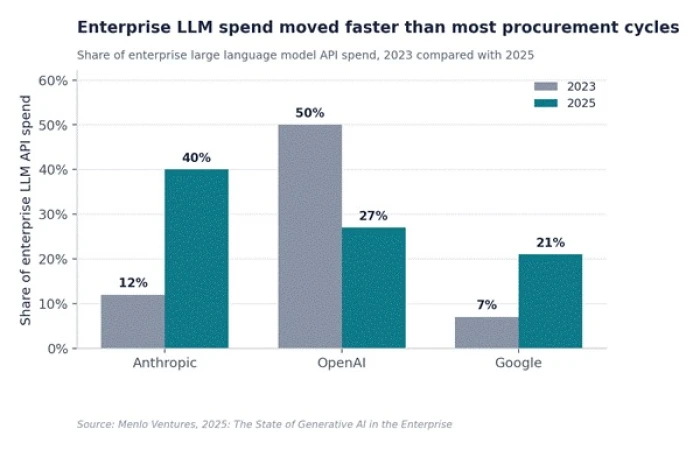
Figure 4: Enterprise LLM API spend share shifted substantially in two years, faster than most organisations complete a full vendor review. Source: Menlo Ventures.
The consequence is visible in enterprise spending. Anthropic's share of enterprise LLM API spend moved from 12% in 2023 to 40% in 2025, while OpenAI's fell from roughly 50% to 27% and Google's rose from 7% to 21%. Whatever standard an enterprise set in 2023 was unlikely to still be the strongest available option by 2025, and there is little reason to expect 2027 to resemble 2026.
2. Price compression rewrites the arithmetic
Token prices compressed by roughly 80% between early 2025 and early 2026. Batch processing typically carries a 50% discount and prompt caching can cut cached input costs by up to 90%. A workload that looked marginal at 2024 prices can become obviously worth relocating, and cost models built on sticker price API rates tend to fall apart once real inference volume arrives.
3. A capability gap opens in one specific job
Switching is rarely wholesale. It happens per task. Coding, long document analysis, research synthesis and image generation each have their own leader at any given moment, and teams increasingly move a single workload rather than an entire account. Anthropic's sustained run at the top of coding benchmarks pulled developer workloads specifically, which is why the enterprise share shift looks sharper than the consumer one.
4. Trust and brand events
Sensor Tower recorded a measurable spike in uninstalls following OpenAI's February 2026 agreement with the United States Department of Defense. In a category where switching takes minutes, values alignment behaves like a product attribute rather than a soft consideration. Vendors underestimate this at their cost.
5. The tool simply disappears
Roughly one in eleven tracked AI tools has already shut down or been acquired. For buyers, vendor viability has become a live selection criterion rather than a formality, particularly in crowded categories funded on the assumption of continued cheap capital.
Where Switching Is Not Happening
Coverage of AI churn tends to generalise from the noisiest categories. The data does not support that generalisation.
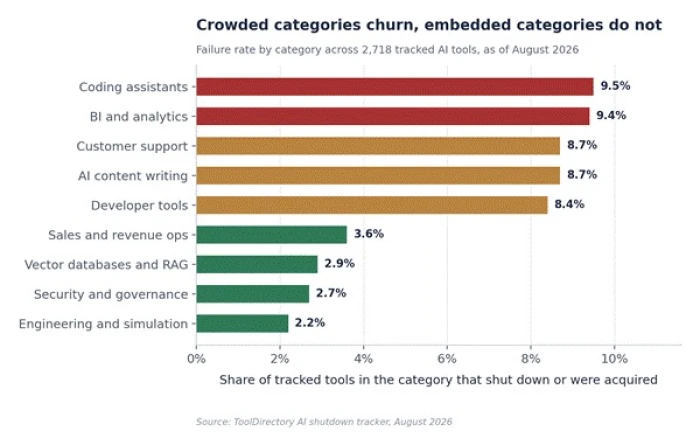
Figure 5: Failure rates diverge sharply by category. Source: ToolDirectory AI shutdown tracker, August 2026.
Categories with deep integration requirements and compliance friction show failure rates near 2%, while crowded application categories with shallow integration run above 9%. Engineering and simulation, security and governance, vector databases and revenue operations tooling are not experiencing anything resembling a churn wave. Coding assistants, analytics dashboards and content writing tools are.
A second distinction matters even more. Menlo Ventures found that about 11% of enterprises had switched model providers, while 66% had upgraded within the same vendor. Most of what gets reported as switching is version upgrading, which is a very different behaviour with very different costs. Adding is also more common than replacing: 37% of enterprises now run five or more models in production, which means a new vendor entering the stack frequently displaces nothing at all.
The Cost Nobody Prices In
- Cheap switching is not the same as free switching, and the bill arrives somewhere other than the invoice.
- Boston Consulting Group research found a measurable productivity drop among workers running four or more AI tools simultaneously, driven by the coordination cost of maintaining separate mental models.
- Tool fatigue costs the average worker around 51 minutes a week, or roughly 44 hours a year, before any migration work is counted.
- About 17% of workers switch between tabs, platforms or apps at least 100 times a day, and knowledge workers averaged 11 applications in 2023 against six in 2019.
- Around 68% of CIOs plan to consolidate vendor agreements over the coming year, which is the organisational immune response to exactly this problem.
The resolution is that switching is often rational at the portfolio level and expensive at the workflow level. Moving a clearly defined workload to a better model is usually sound. Rotating an entire team through a new interface every quarter is usually not. Those two decisions get conflated constantly, and the conflation is what produces tool sprawl.
A Practical Test Before Switching
A switch is worth making when the gain sits in the workload and the cost sits below the memory layer. The signals below separate the two cases.
| Signals that justify a switch | Signals a switch will not fix |
| A named workload is measurably better on the alternative, tested on real inputs rather than demos | The current tool is unfamiliar rather than inadequate, and training was never completed |
| Unit economics changed materially, for example a price cut or a cheaper model tier for the same quality | Output quality is poor because the underlying data or process is poor |
| The vendor has missed roadmap commitments or shows viability risk in a high failure category | A competitor announced a benchmark result that has not been reproduced on the team's own tasks |
| Compliance, residency or governance requirements cannot be met by the incumbent | The team has not defined what success would look like after the move |
| Integrations run through a portable layer, so the wiring survives the change | Most of the value sits in accumulated context that cannot be exported |
For a quick estimate, score each of the four Switch Cost Stack layers from 0 to 10 for the specific tool in question. A total above 20 means the move needs a staged migration plan and an owner. A total below 10 means the switch is close to free, and the only remaining question is whether the alternative is genuinely better on the work that matters.
What the Next Twelve Months Look Like
Gartner expects organisations to deploy small task specific models at three times the volume of general purpose models by 2027, with value accruing to the orchestration platforms that route workloads across a portfolio. If that holds, switching stops being an event and becomes a routing decision made continuously and largely invisibly.
Two consequences follow. Vendors will start marketing portability as a feature rather than resisting it, because buyers have learned to price lock-in. And the competitive question shifts from which assistant is best to which assistant should handle a given job this quarter. The organisations that handle this well will be the ones that decided in advance where their accumulated context lives, and kept everything above that layer replaceable.
Conclusion
AI tool switching is becoming more common because moving between platforms is easier, pricing changes faster, and different tools increasingly lead in different tasks. But switching only makes sense when the alternative delivers a clear improvement in cost, capability, reliability, or workflow fit.
The goal should not be to constantly chase the newest AI tool. It should be to keep important workflows portable, test alternatives on real work, and switch only when the benefits outweigh the cost of migration.
As AI ecosystems become more flexible, the smartest approach may not be choosing one permanent winner, but knowing which tool is best for each job and when it is worth changing.