Here is the uncomfortable truth most vendors will not put on a slide: your business is already exposed to AI risk, whether or not you have approved a single tool. Someone on your team pasted a client contract into a chatbot last week. A marketing script is quietly drafting product claims you have never reviewed. A vendor you pay every month just switched on an AI feature and did not tell you. AI risk is not a future problem waiting for a policy. It is a present condition waiting for a framework.
This guide gives you that framework. Not a theory, and not a 90-page compliance manual nobody reads, but a practical, seven-step operating model you can start using this quarter. It works for a ten-person agency and for a company running models in production, because the logic scales. Along the way you will find the current numbers that make the case, the regulatory clocks that are already ticking, and templates you can lift straight into your own risk register.
What you will walk away with A clear definition of the risks AI actually creates for a business, a way to find every AI system you are running (including the ones you did not sanction), a method to score and tier those systems, a controls library matched to each risk, and a reporting rhythm that keeps leadership informed without drowning them. |
What AI risk really means for a business
It helps to be precise. AI risk is not one thing. It is a family of related risks that behave differently and need different controls. A common mistake is to treat all of it as a security problem and hand it to the IT team, or to treat all of it as an ethics problem and hand it to legal. Both are half right, which is another way of saying both are wrong.
The eight categories below cover almost everything a business will run into. You do not need to memorise them. You need to recognise that a single AI tool, say a customer-facing support assistant, can carry five of these at once.
| Risk category | What it looks like in practice | Who usually feels it first |
| Model and output risk | Confident wrong answers, hallucinated facts, quality drift as the model or data changes over time. | Customers, front-line staff |
| Data and privacy risk | Sensitive data, PII, or trade secrets leaking into a third-party model or its training set. | Legal, affected individuals |
| Security risk | Prompt injection, jailbreaks, data poisoning, model theft, or AI-assisted attacks against you. | Security, engineering |
| Bias and fairness risk | Systematically worse outcomes for a protected group in hiring, lending, or pricing. | Applicants, regulators, PR |
| Compliance and legal risk | Breaching a regulation, an AI-specific law, copyright, or a contractual promise you did not know you made. | Compliance, the board |
| Operational risk | Over-reliance on a tool that fails silently, or an automated decision no human can explain. | Operations, customers |
| Third-party and vendor risk | A supplier's AI feature, or an unapproved tool an employee adopted, that you cannot see or control. | Procurement, security |
| Reputational and ethical risk | A visible AI failure or an ethically tone-deaf use that damages trust faster than any fine. | Executives, the whole brand |
Notice the last column. AI risk is rarely contained to the team that deployed the tool. That is exactly why it needs a framework that cuts across the organisation rather than living inside one department.
A quick reality check for the S&P 500 When large US companies were asked to disclose their most material AI risk, the single most commonly cited concern was not hackers or regulators. It was reputational damage from failed or overpromised AI, named by 38 percent of firms, ahead of both cybersecurity and compliance. For many businesses, the biggest AI threat is their own execution. |
Why this matters now: the data and the deadlines
There are two forces pushing AI risk up the priority list at the same time. The first is that things are going wrong more often. The second is that the law is catching up. Ignoring either one is expensive.
Incidents are climbing, and so is the cost of getting it wrong
Stanford's AI Index recorded 362 publicly reported AI incidents in 2025, up from 233 the year before. That is a 55 percent increase in twelve months, and it counts only the failures visible enough to make the record.
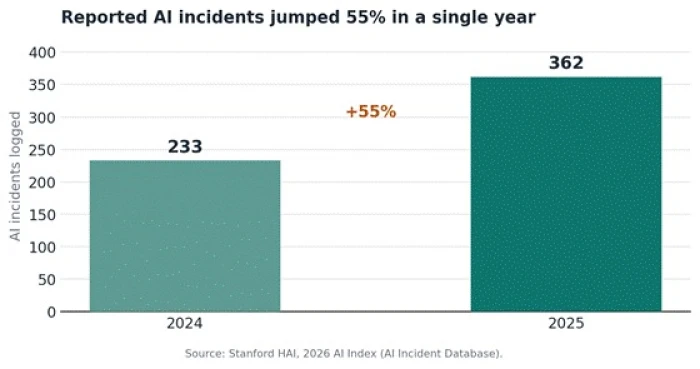
Reported AI incidents rose sharply year over year (Stanford HAI, 2026 AI Index).
The financial side is just as pointed. IBM's 2025 Cost of a Data Breach study put the global average breach at 4.44 million dollars, and the US average above 10 million for the first time. The AI-specific finding is the one to sit with: one in five breached organisations were compromised through shadow AI, meaning unsanctioned tools that staff adopted on their own. Those breaches cost an extra 670,000 dollars on average, ran longer, and leaked more customer data. Among organisations that suffered an AI-related breach, 97 percent lacked basic AI access controls, and 63 percent had no AI governance policy at all.
The gap between using AI and governing it Around three quarters of organisations now have some kind of AI usage policy, yet only about a third have adopted a formal governance framework, and by one strict measure just 8 percent have a comprehensive one. Meanwhile nearly 74 percent are already giving agentic AI access to their data and processes, but only 20 percent have a tested plan for when it fails. That space between adoption and governance is precisely where the incidents and the costs live. |
The regulatory clock is already running
If you sell into or operate in the European Union, the EU AI Act now applies to you even if your company sits in Gurugram, Dubai, or anywhere else. It reaches any provider or deployer whose AI output is used in the EU. The Act entered into force on 1 August 2024 and phases in over several years:
• Since February 2025: a ban on unacceptable-risk practices (such as social scoring and certain manipulative systems), plus an AI literacy duty for staff.
• Since August 2025: obligations for general-purpose AI model providers.
• From 2 August 2026: general application, including the Article 50 transparency rules that cover chatbots and AI-generated content.
• From 2 December 2027: the heavy obligations for stand-alone high-risk systems under Annex III, such as AI used in hiring, credit scoring, and education. This was recently deferred from 2026 by the Digital Omnibus package, which bought most teams roughly sixteen extra months.
• From 2 August 2028: high-risk AI embedded in regulated products under Annex I.
Penalties are deliberately severe, reaching up to 35 million euros or 7 percent of global annual turnover, whichever is higher. That ceiling sits above the equivalent GDPR figure. The point is not to frighten you into inaction. It is that a phased timeline is a gift: it gives you time to build the framework in this guide before the strict deadlines land, rather than scrambling afterward.
Two clarifications worth keeping. First, the exact high-risk dates are still settling as the Digital Omnibus is formally adopted, so treat late 2027 as a planning anchor and confirm the final text closer to the time. Second, the EU is not the only game in town. India's Digital Personal Data Protection framework, sector rules in finance and health, and a growing list of national AI laws all point the same direction. A single well-built internal framework satisfies most of them at once, which is far cheaper than chasing each law separately.
The framework at a glance: a seven-step loop
Good AI risk management is a loop, not a checklist you complete once. Models change, vendors ship new features, staff find new uses, and regulations move. The framework below is built to be run continuously, with the whole cycle reviewed at a set cadence rather than only after something breaks.
| Step | What you do | The question it answers |
| 1. Govern | Set up ownership, a policy, and an accountable decision-making body. | Who is responsible when AI goes wrong? |
| 2. Map | Discover and inventory every AI system, sanctioned or not. | What AI are we actually running? |
| 3. Classify | Tier each system by potential impact and exposure. | Which systems deserve the most attention? |
| 4. Assess | Identify and measure the specific risks per system. | What could go wrong, and how badly? |
| 5. Control | Apply mitigations matched to each risk and tier. | How do we reduce the risk to an acceptable level? |
| 6. Monitor | Watch live systems, test them, and stand up incident response. | Is it still safe now that it is in use? |
| 7. Improve | Report to leadership, review, and feed lessons back in. | How do we get better each cycle? |
Steps two through seven do the hands-on work on specific systems. Step one, governance, sits above all of them and never switches off. If you only remember one thing about the shape of this, remember that governance is the frame and the other six steps are the picture inside it.
Step 1. Set up governance and ownership
Almost every failed AI program shares one root cause: nobody owned the risk. The tool belonged to marketing, the data belonged to IT, the liability belonged to legal, and the decision to ship belonged to whoever was in the room. Governance fixes this by naming owners before anything is deployed.
You do not need a large bureaucracy. You need three things: a person who is accountable, a small cross-functional group that meets on a schedule, and a short written policy that tells everyone else what is and is not allowed.
Name a single accountable owner
Larger organisations increasingly appoint a Chief AI Officer, a role that reached about 26 percent of organisations in 2025, up from 11 percent two years earlier. The title matters less than the accountability. In a smaller company this can be a founder, the COO, or the head of operations wearing an extra hat. What cannot happen is the owner being a committee, because a committee cannot be paged at 11pm when a model starts behaving badly.
The ownership dividend This is not overhead for its own sake. Companies with a clearly accountable AI leader see roughly 10 percent greater return on AI spend and are meaningfully more likely to outperform peers on innovation. Organisations with structured, orchestration-led governance report about 29 percent lower losses from AI failures and 20 percent higher return. Governance and results move together. |
Stand up a lightweight governance group
Bring the right functions to one recurring meeting. A workable split of responsibilities looks like this.
| Role | Responsibility in the AI program |
| Board or owners | Set risk appetite, review the AI risk picture at least quarterly, approve high-tier uses. |
| Accountable AI owner | Owns the program end to end, makes the go or no-go call, reports upward. |
| Governance group | Reviews new use cases, maintains the inventory and policy, tracks incidents and actions. |
| Legal and compliance | Maps regulatory obligations, reviews contracts and disclosures, signs off on high-risk cases. |
| Security and IT | Owns access controls, monitoring, data protection, and the technical side of incident response. |
| Business and technical leads | Register their own tools, run day-to-day controls, escalate issues early. |
Write a short, usable AI policy
A good AI policy fits on two pages and answers the questions people actually have: which tools are approved, what data must never be pasted into a public model, when a human has to review the output, when a use case must be brought to the governance group, and what happens if the rules are ignored. If your policy is longer than your holiday policy, nobody will read it, and unread policies are the ones that fail in an audit.
Step 2. Discover and map every AI system
You cannot govern what you cannot see, and most organisations cannot see most of their AI. Over half of companies still lack a systematic inventory of the AI they run. The single unmonitored tool is the one that shows up in the breach report.
Mapping means building and maintaining a register of every AI system touching your business. Cast the net wider than you think you need to. Your inventory should capture at least four types:
1. Tools you built: models and AI features your own team developed or fine-tuned.
2. Tools you bought: AI products you pay for directly, from writing assistants to analytics platforms.
3. AI inside your vendors: features quietly added to software you already use. Ask suppliers directly what AI they have switched on and what data it touches.
4. Shadow AI: the unapproved tools staff use on their own. Surface these with an amnesty, a short survey, and network or browser visibility rather than punishment, because punishment just drives it deeper underground.
For each entry, record a minimum useful set of fields. This becomes the backbone of everything that follows.Step 3. Classify each system by risk tier
Step 3. Classify each system by risk tier
Not every AI system deserves the same scrutiny. A tool that suggests email subject lines is not the same as one that screens loan applications, and treating them identically wastes effort on the trivial while starving the dangerous. Tiering lets you spend your attention where it counts.
Borrow the logic the EU AI Act uses, because regulators around the world are converging on it. Rate each system by the impact if it fails and the exposure it carries, then place it in one of four tiers.
| Tier | Description | Example | What it requires |
| Unacceptable | Uses that are banned or clearly unethical. | Social scoring, covert manipulation. | Do not deploy. Remove if found. |
| High | Affects people's rights, money, safety, or livelihood. | Hiring, credit, medical triage, safety systems. | Full assessment, human oversight, documentation, sign-off. |
| Limited | Interacts with people or generates content, lower stakes. | Customer chatbot, marketing copy generator. | Transparency to users, output review, basic monitoring. |
| Minimal | Internal, low impact, easily reversible. | Meeting summaries, code autocomplete. | Light-touch: policy and acceptable-use only. |
Two practical notes. Tiers move: a chatbot that starts giving financial advice has just promoted itself to high risk, so re-tier whenever a system's job changes. And when you are genuinely unsure between two tiers, choose the higher one. The cost of over-controlling a minimal tool is a little wasted time. The cost of under-controlling a high-risk one is in the breach and fine figures above.
Step 4. Assess and measure the specific risks
Now you get concrete. For each system, especially the high and limited tiers, work through the eight risk categories from earlier and ask three questions per relevant risk: how likely is it, how bad would it be, and how would we even know it happened? That last question catches more real problems than the first two, because a risk you cannot detect is one you are simply hoping does not occur.
Capture the answers in a simple risk register. The scoring does not need to be scientific to be useful; the discipline of writing it down is most of the value. On average, organisations now actively manage four AI risks per system, up from two in 2022, which tells you both that awareness is rising and that most are still not seeing the full picture.
| Field | Example entry for a customer support assistant |
| System | AI support chatbot on the help centre (Limited tier) |
| Risk | Hallucinated policy answers that commit the company to something false |
| Likelihood | Medium |
| Impact | High: could create a binding promise or a compliance breach |
| Detection | Weekly sampling of transcripts, plus a user thumbs-down signal |
| Owner and control | Support lead; retrieval limited to approved docs, disclaimer shown, human handoff for edge cases |
For high-risk systems, go further than sampling. Bias testing on real outcome data, structured red teaming to find how the system can be pushed off the rails, and documented evaluation results are the difference between a program that survives an audit and one that only looks tidy. Fewer than one in five organisations currently run regular red teaming, which is a genuine gap you can turn into an advantage.
Step 5. Design and deploy your controls
A risk you have assessed but not treated is just a documented liability. Controls are how you actually reduce risk to a level your leadership has agreed to accept. The good news is that a fairly small library of controls, applied in the right combination, covers most situations. Match the controls to the risk and the tier rather than applying everything everywhere.
| Control | What it does | Best against |
| Acceptable-use policy | Sets clear rules for what staff may do with which tools and data. | Shadow AI, data leakage |
| Access controls and DLP | Restricts who can use a system and stops sensitive data leaving. | Privacy, security, data risk |
| Human-in-the-loop review | Requires a person to approve consequential outputs before they act. | Model, operational, bias risk |
| Input and output guardrails | Filters prompts and responses, grounds answers in approved sources. | Model, security, reputational |
| Testing and red teaming | Actively probes for failures, bias, and jailbreaks before users find them. | Bias, security, model risk |
| Monitoring and logging | Records activity and watches for drift, misuse, and anomalies. | Operational, security, detection |
| Vendor due diligence | Checks supplier security, data handling, and certifications before you buy. | Third-party, compliance risk |
| Transparency and disclosure | Tells users they are dealing with AI and labels AI-generated content. | Compliance, ethical, legal risk |
| Data governance | Minimises, classifies, and controls the data AI systems can touch. | Privacy, IP, compliance risk |
| Training and AI literacy | Equips staff to use AI safely and spot when something is off. | Nearly every category |
Step 6. Monitor, test, and prepare to respond
AI systems are not appliances you install and forget. They drift as the world changes around them, vendors update models underneath you, and users find creative new ways to misuse them. Monitoring is how you keep the risk picture current after launch, and incident response is how you limit the damage when something slips through anyway, because eventually something will.
Monitor what actually predicts trouble
• Output quality and drift: sample real outputs on a schedule and watch for accuracy sliding over time.
• Usage patterns: sudden spikes, off-hours activity, or use well outside the intended purpose.
• User signals: complaints, thumbs-down, and support tickets are your cheapest early-warning system.
• Vendor changes: model updates and new features that can silently change behaviour and your exposure.
Have a plan before you need one
Only about 20 percent of organisations have a tested AI incident response plan, even as three quarters hand AI access to their systems. Do not be in the majority here. A workable plan does not need to be elaborate, it needs to exist and to have been rehearsed at least once.
- Define what counts as an AI incident, so people know when to raise the alarm rather than quietly hoping it resolves.
- Name who to call and give them the authority to pause or shut down a system.
- Write the containment steps: how to disable the tool, cut its data access, and switch to a manual fallback.
- Prepare communication, including who tells customers, regulators, and leadership, and how quickly.
- Run a post-incident review and feed every lesson straight back into Steps 4 and 5.
Speed pays for itself. Teams that use AI and automation extensively in their own security cut breach discovery time by roughly 80 days and lowered costs by around 1.9 million dollars compared with those that did not. Detection and response are where good money is saved.
Step 7. Report, review, and improve
The final step closes the loop and turns a one-off project into a living program. It has two parts: telling leadership the truth on a schedule, and using each cycle to get a little better than the last.
Report in the language leadership actually cares about
Boards do not want model architecture. They want to know whether AI is creating value, where the exposure sits, and whether it is under control. A one-page dashboard each quarter usually does it: how many systems by tier, open high-risk items, incidents this period, controls in place versus planned, and the regulatory deadlines coming up. This rhythm is not just hygiene. Organisations that discuss AI at every board meeting are dramatically more likely to report high return on their AI investment than those that rarely do.
Treat the whole thing as a strategy, not a chore
The strongest argument for all of this is not fear of fines. It is that disciplined AI programs simply perform better. Organisations with a formal AI strategy report an 80 percent success rate on adoption, against 37 percent for those winging it. That 43-point gap is the real return on the work in this guide.
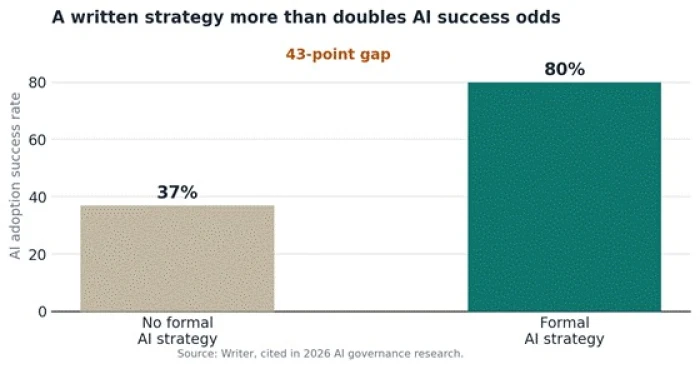
A written strategy and governance more than double the odds of AI success (Writer, 2026).
Each cycle, ask a few honest questions. What new AI appeared that we did not know about? Which controls did not hold? What did the incidents teach us? Where did a regulation move? Then update the inventory, the tiers, and the controls, and run the loop again. Maturity is not a certificate you earn once. It is the habit of doing this on a schedule while your competitors do it only after something breaks.
How the framework maps to NIST, ISO 42001, and the EU AI Act
This framework is not a competitor to the established standards. It is a plain-language way to operate them. If your customers, auditors, or regulators expect a recognised name, here is how the seven steps line up with the three references that matter most in 2026.
| This framework | NIST AI RMF function | ISO/IEC 42001 | EU AI Act connection |
| 1. Govern | Govern | Leadership, policy, roles | Risk management system, accountability |
| 2. Map | Map | AI system inventory, context | System classification duty |
| 3. Classify | Map | Impact assessment | Risk tiers (the Act's core logic) |
| 4. Assess | Measure | Risk assessment, evaluation | Conformity assessment inputs |
| 5. Control | Manage | Controls and treatment | Data governance, human oversight |
| 6. Monitor | Manage and Measure | Operation and monitoring | Post-market monitoring, logging |
| 7. Improve | Govern | Continual improvement | Ongoing compliance and review |
A note on choosing. The NIST AI Risk Management Framework, released in 2023 and organised around Govern, Map, Measure, and Manage, is voluntary and the most common starting point, used by around a third of organisations. ISO/IEC 42001 is the certifiable management-system standard, useful when you want a badge to show customers, adopted by a similar share. The EU AI Act is law, not a choice, if you touch the EU market. You do not have to pick just one. Build the framework once, and you can map it to whichever names your stakeholders ask for.
Your first 90 days: a realistic starting plan
Frameworks fail when they arrive as one enormous project. They succeed when they start small and compound. Here is a sequence that a busy team can actually follow without stopping the rest of the business.
| Window | Focus | Concrete outputs |
| Days 1 to 30 | See clearly and assign ownership | Name an accountable owner; run the inventory including shadow AI; draft a two-page policy; declare an amnesty so people register tools honestly. |
| Days 31 to 60 | Prioritise and protect the risky few | Tier every system; run a full assessment on the high-risk ones; put basic access controls and human review on anything customer-facing; brief staff. |
| Days 61 to 90 | Make it a habit | Stand up quarterly governance meetings; write and rehearse a simple incident plan; build the one-page board dashboard; schedule the next review. |
At the end of ninety days you will not be finished, because this work is never finished. But you will have moved from the group that hopes nothing goes wrong to the group that would know what to do if it did. That shift alone puts you ahead of most of the market.
Common mistakes that quietly sink AI programs
• Writing the policy and stopping there. A policy without an inventory and controls is a document, not a defence. Three quarters have the policy; far fewer have the framework behind it.
• Treating AI risk as purely an IT problem. Bias, reputation, and legal exposure do not live in the server room. Keep the group cross-functional.
• Ignoring shadow AI. The tools you have not sanctioned are the ones running without any controls at all, and they are one in five breaches.
• Controlling everything equally. Over-governing a meeting-summary tool while under-governing a hiring model is the worst of both worlds. Tier first.
• Buying a platform before building the basics. Governance tooling helps, but it multiplies discipline you already have; it cannot create it.
• Doing it once. A framework reviewed annually and forgotten in between is a framework that will be out of date the moment a vendor ships an update.
The bottom line
AI risk management has a reputation for being either a compliance headache or a brake on innovation. It is neither. Done well, it is the thing that lets you say yes to AI with confidence, because you know what you are running, you know what could go wrong, and you know what you would do about it.
The numbers make the case on their own. Incidents rose by more than half in a single year. A fifth of breaches now involve tools nobody approved. And companies that treat AI as a governed strategy succeed at more than double the rate of those that improvise. The gap between those two groups is not talent or budget. It is a framework, applied consistently.
You now have that framework. Seven steps, run as a loop: govern, map, classify, assess, control, monitor, improve. Start this week with the two that cost almost nothing and change the most, naming an owner and building your inventory, and let the rest follow. The businesses that win with AI over the next few years will not be the ones that used it first. They will be the ones that used it without blowing themselves up, and that is a choice you can make starting today.