
You found the thing. The exact one. And it is somehow forty percent cheaper on a site you have never heard of. Your thumb is hovering over the Buy button, and a small voice in the back of your head whispers: is this place real?
That voice is worth listening to. Online shopping is wonderful right up until the moment your money disappears into a store that was never going to send you anything. The good news is that legitimate shops and fake ones leave very different fingerprints, and once you know where to look, telling them apart takes about as long as reading this sentence a few times over.
This guide walks you through every check that matters, from the quick gut read to the deeper digging, so you can hand over your card details with confidence or close the tab and keep your money.
First, why this is worth a minute of your time
Most people assume a scam store looks obviously broken. In reality, the dangerous ones look polished. They lift product photos from real brands, clone checkout pages, and buy ads that sit right next to legitimate ones in your feed. The problems only show up after you have paid.
When an online purchase goes wrong, it usually goes wrong in one of a handful of predictable ways. Here is what actually happens to people:

Figure 1. The most common ways a purchase from a bad store ends badly.
The single biggest category is simple: you pay, and nothing ever arrives. Close behind are counterfeit goods and stolen card details. None of these require you to be careless. They just require the store to be dishonest and you to have no way of knowing in advance. The checks in this guide are how you get that way of knowing.
The 60-second check: your first read on any store
Before you dig into anything technical, run a quick gut check. These are the signals you can read in under a minute, without leaving the page you are already on. Think of it as a first impression that is actually useful.
1. Look at the web address before anything else
Your browser's address bar is the most honest thing on the page. A scammer can fake a logo, but the address is harder to disguise. Read it slowly, left to right.
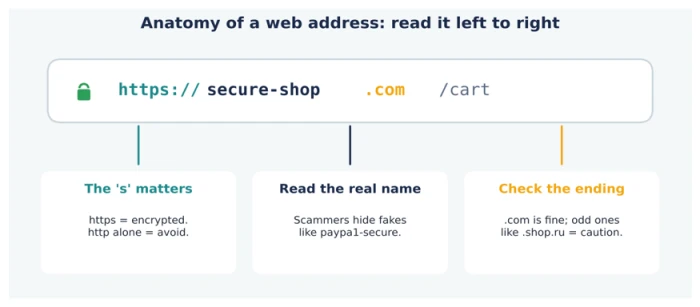
Figure 2. How to read a web address the way a cautious shopper does.
Start with the padlock and the https:// at the front. That s means the connection is encrypted, so the details you type cannot be read in transit. If a checkout page shows plain http with no padlock, stop there and do not enter anything.
Padlock myth, cleared up A padlock means the connection is encrypted. It does not mean the owner is honest. Plenty of scam sites have a padlock now, because certificates are free. So treat https as the bare minimum, a door you need before you walk in, not proof the house is safe. |
Then read the actual name. Scammers love look-alikes: a zero instead of an o, an extra word tacked on, or a strange ending like .shop.ru on a store claiming to be a well-known brand. If the name feels like it is impersonating someone, it probably is.
2. Trust your price instinct
If a store is selling everything at a price that makes no commercial sense, there is usually a reason, and it is rarely generosity. Steep, across-the-board discounts on brand-new, in-demand products are the oldest lure in the book. A real sale is specific. A fake one is suspiciously total.
3. Scan for signs a human runs the place
Legitimate businesses want you to be able to reach them. Fakes want the opposite. In your first read, glance for a real street address, a phone number, and an email that uses the store's own domain rather than a free Gmail or Outlook account. Clumsy grammar, mismatched fonts, and broken links all whisper that nobody is really minding the shop.
Not every trust signal is worth the same
Once you move past the first impression, it helps to know which signals actually carry weight. Some feel reassuring but mean little. A pile of five-star reviews on the store's own website, for example, is easy to fake. An independent review on a platform the store does not control is far harder to invent.
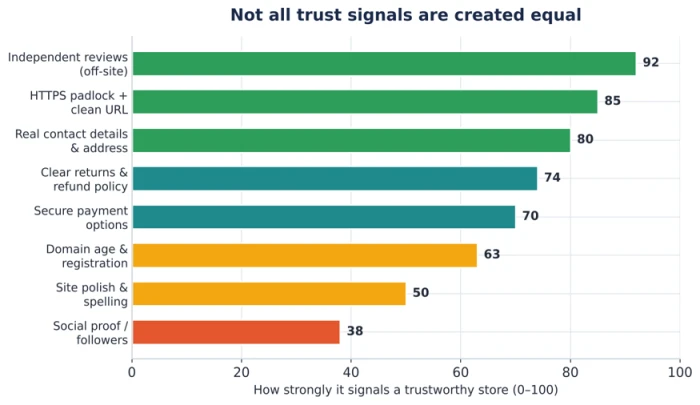
Figure 3. Trust signals ranked by how much they genuinely tell you about a store.
Notice the pattern: the signals that are hardest for a scammer to fake sit at the top, and the ones that are easiest to manufacture sit at the bottom. A slick website and a big follower count feel convincing, but they are also exactly what a well-funded scam invests in first. Weight your judgement accordingly.
The deeper checks: when you want to be sure
For a bigger purchase, or any store you have never used, it is worth spending a few extra minutes. These checks move beyond gut feel into things you can verify.
Search for the store's name plus the word 'scam' or 'reviews'
This is the fastest high-value check there is. Open a new tab and search the store name alongside scam, legit, or reviews. Real stores leave a trail: Reddit threads, Trustpilot pages, news mentions, YouTube unboxings. A store that has existed for two years and sold to thousands of people cannot hide. A store that popped up last month to sell you one thing has nothing behind it, and that silence is itself an answer.
Check how old the website is
Most scam stores are young, because they get shut down and rebuilt under new names constantly. You can look up a domain's registration date with a free WHOIS lookup, or with a reputation checker that scores a site across several signals at once. A domain registered years ago is not a guarantee of honesty, but a domain registered a few weeks ago on a store promising deep discounts is a serious warning.
A faster way to run several checks at once Tools like a website reputation checker (for example, SiteScano) bundle many of these signals into a single score, looking at security, domain age, content quality, and link and review patterns together. It will not replace your own judgement, but it is a quick way to get a second opinion before you commit. |
Read the return and refund policy properly
A genuine store expects some orders to come back and plans for it. That means a findable returns policy with a real timeframe, a return address, and a clear process. If the policy is vague, buried, written in broken sentences, or simply not there, assume that getting your money back will be just as difficult.
Look at how they want you to pay
This one is close to a dealbreaker. Honest stores accept payment methods that protect you: credit cards and well-known wallets like PayPal both let you dispute a charge and claw money back. Scammers push you toward methods that do the opposite. If a checkout insists on a bank transfer, cryptocurrency, or gift cards, treat it as a flashing red light. Those payments are gone the moment you send them.
Why smart people still get caught?
None of this is about being gullible. Scam stores are engineered to bypass careful thinking, usually by adding urgency and lowering your guard at the exact moment you are most excited about a purchase. Understanding the trigger helps you resist it.
The two biggest triggers, an unbeatable price and a tempting social media ad, both work by getting you to act before you check. The countdown timer on the checkout page is not a coincidence. It exists to stop you from opening a new tab and searching the store's name. The simple defence is to always give yourself that extra tab.
Here is the encouraging part. No single check is perfect, but they stack. Each one you add meaningfully raises the odds that you are dealing with a real store.
Side by side: a real store versus a fake one
To pull it all together, here is how a legitimate store and a risky one tend to score across the signals that matter. The gap is usually obvious once you line them up.
And in plain words, the same comparison as a quick-reference table you can keep:
| What you check | Legit store looks like | Scam store looks like |
|---|---|---|
| The web address | https:// with a padlock, clean spelling | http only, or a look-alike like amaz0n-deals.shop |
| Contact details | Phone, email and a real address | A lone contact form, no address anywhere |
| Prices | In line with the rest of the market | 90% off everything, all the time |
| Reviews | Found on Google, Trustpilot, Reddit | Only glowing 5-star quotes on their own page |
| Payment | Card, PayPal, familiar wallets | Bank transfer, crypto or gift cards only |
| Return policy | Clear window, address to ship back to | Vague, buried, or simply missing |
| Age of the site | A domain that has existed for years | Registered three weeks ago |
The cheat sheet: green flags and red flags
If you remember nothing else, remember these two lists. Green flags are reasons to relax. Red flags are reasons to pause, dig deeper, or walk away.
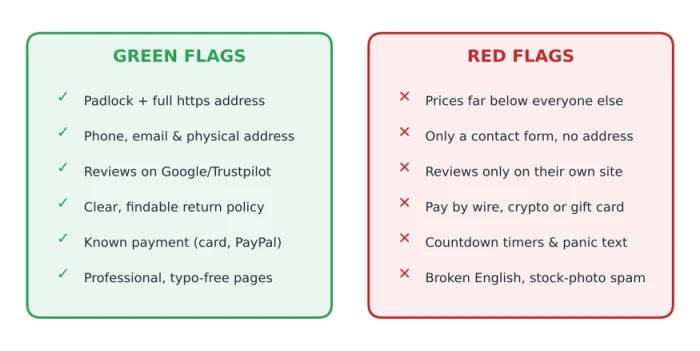
Figure Keep this mental checklist handy every time you reach a new checkout.
Your before-you-pay routine, step by step
Turn all of this into a short habit. The next time you are about to buy from a store you do not know, run through these in order. The whole thing takes two to three minutes and has saved a lot of people a lot of money.
- Read the URL. Check the address bar for https and a padlock, and read the domain name carefully for look-alikes.
- Search the name. Open a new tab and search the store name with 'reviews' and 'scam'. See what the wider internet says.
- Find the humans. Look for a real address, phone number, and a branded email. Silence here is a warning.
- Check the age. Run a WHOIS or reputation check. A brand-new domain selling big discounts deserves suspicion.
- Test the exits. Read the returns policy and confirm you can pay by card or PayPal, never only by transfer, crypto, or gift card.
- Listen to your gut. If anything still feels off, trust that feeling. There will always be another store.
If you already paid and now suspect a scam Act quickly. Contact your bank or card provider and ask about a chargeback or dispute. Change any password you reused on that site. Keep every order confirmation and email as evidence. And report the store to your national consumer-protection or cybercrime body so the next person gets a warning you did not have. |
The bottom line
A legitimate online store is not trying to trick you, so it leaves all the normal signs of a real business out in the open: a secure address, ways to reach a human, honest prices, fair returns, and payment methods that protect you. A scam store has to hide or fake those same things, and it can never hide all of them at once.
You do not need to be an expert or paranoid. You just need to slow down for a minute, read a few signals, and give yourself permission to close the tab when something does not add up. Do that consistently, and the odds move firmly onto your side, which, after all, is where they belong.
Shop boldly. Just verify first.